

How To Draw Someone Kneeling From The Front
Of all parts of the trunk, the hand is by many considered to be the hardest to describe. We all have stories of how, early on, we would keep our characters' hands behind their backs or in their pockets, avoiding as much equally possible the job of tackling hands. However paradoxically, they are our about readily available reference, being in our field of vision every moment of our lives. With but 1 actress accessory, a small mirror, we can reference hands from all angles. The only real challenge, then, is the complexity of this remarkably articulated organ: it's almost like drawing a small figure onto a larger 1, one doesn't know where to commencement.
In this tutorial we will deconstruct the hand's own beefcake and indeed demystify it, and so that when you look at a mitt for reference, you tin can brand sense of information technology as a group of simple forms, easy to put together.
I use the following abbreviations for the fingers:
- Th = thumb
- FF = forefinger
- MF = middle finger
- RF = ring finger
- LF = pinkie
Nuts of the Paw
Here'due south a quick expect at the os structure of the hand (left). In blue, the 8 carpal bones, in imperial, the five metacarpal bones, and in pink, the 14 phalanges.
As many of these bones cannot move at all, nosotros can simplify the basic structure of the hand: the diagram on the correct is all yous really need to remember.


Note that the actual base of the fingers, the joint that corresponds to the duke, is much lower than the apparent base formed by flaps of skin. This volition be important to describe bending fingers equally nosotros will encounter later.
Based on the above, a elementary mode of sketching the hand is to get-go with the basic form of the palm, a flat shape (very much like a steak, but roundish, squarish, or trapezoidal) with rounded angles, then attach the fingers :


If you lot have a hard fourth dimension drawing fingers, information technology's very helpful to think of them, and describe them, as stacks of three cylinders. Cylinders are easy to draw under whatever bending, taking away much of the headache of drawing fingers in perspective. Notice how the bases of the cylinders are exactly the folds you need to draw when the finger bends.


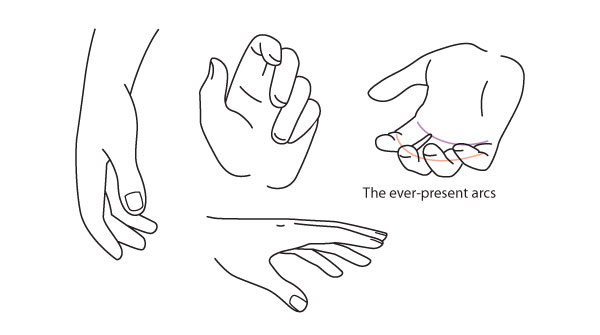
This is of import: The joints of the fingers are not aligned on straight lines, but fall onto concentric arches:


In add-on, fingers are non straight, but curve slightly towards the space between MF and RF. Showing this even subtly gives life to a cartoon:


Permit united states not forget the fingernails. There is no demand to always depict them, indeed they are a degree of detail that only looks right when the easily are seen sufficiently close upwardly, but we are non unremarkably taught how they should look, and because of this, I for i couldn't make them look right for a long time. Here are some notes on the fingernail:


- The fingernail starts halfway upward the top joint of the finger.
- The point where fingernail detaches from flesh varies: some people have it all the way at the edge of the finger, others have information technology very low (dotted line), so in their case the fingernails are wider than they are long.
- Fingernails are not flat, but shaped much like roof tiles, with a curvature ranging from farthermost to very slight. Observe your manus and you may find that this curvature is different for each finger – only this level of realism is unnecessary in cartoon, fortunately.
Proportions
Now, taking the (credible) length of FF equally our base unit, we tin can roughly put down the following proportions:


- The maximum opening betwixt Th and FF opening = 1.5
- The maximum opening betwixt FF and RF = 1. The MF can be closer to either without affecting the total distance.
- The maximum opening between RF and LF opening = i
- The maximum angle between Th and LF is 90º, taken from the very base of the Th's articulation: the fully extended LF is aligned with it.
I said "roughly" considering these do vary with people, sometimes a lot, just call back that deviating from the norm on paper can look wrong. If in doubt, these measurements will e'er look right.
Details
The basic shape is only one challenging attribute of the manus; the other may be the detailing of folds and lines. Who hasn't been frustrated by drawing a hand and not being able to get all these lines to look correct? Let'south expect at fold lines and some measurement details:


- The virtual extension of the inner line of the wrist separates the thumb from the fingers. A pocket-size tendon line may marking the junction of wrist and hand.
- When fingers are close together as above, the pollex tucks a bit under the palm and is partially hidden.
- The FF or RF as sometimes about as long as the MF.
- The folds that mark the knuckles are elliptical or similar parenthesis, only when the hand is flat every bit above they are not pronounced (unless someone has protruding duke, which happens on much-labored hands) and can be fatigued as mere dimples.
- The folds of the finger joints show elliptically on the back side, simply they fade when the fingers are bent. They show as parallel lines on the palm side, but they are more pronounced at the lower joint – typically y'all wouldn't utilise ii lines for the upper joints.
- From the back, the lines of the fingers extend down to the limit of the palm, which makes the fingers look longer from the back.
From the inside, the lines are shorter because the top of the palm is padded, so the fingers look shorter on the palm side. - The lines of the fingers end in are drag lines (these brusk horizontal dashes) on both sides, and on both sides these drag lines all point away from the MF.
Annotation also, in the diagram above, how the fingernails are not drawn fully merely indicated in a subtle way appropriate to the overall level of detailing (which is rather higher than necessary, for purposes of showing all the lines). The smaller the paw yous're cartoon, the less detail you want in it, unless you want it to look old.
I didn't mention the lines of the hand higher up, so permit's take a look at them closely here:


- The most visible lines in the palm: the so-called eye, head and life lines, are where the pare folds when the palm is cupped. Unless your way is very realistic, there'southward no need to draw others, it will look excessive.
- Don't confuse the life line with the contour of the pollex, which becomes visible under certain angles such equally the one on the right. The life line is near concentric with the contour of the pollex, but see how much higher on the palm it originates – the (true) base of the FF, in fact.
- From the side, the padding at the base of each finger appears as a series of curved, parallel bulges.
- These fold lines wrap halfway around the fingers. They are accentuated equally the finger bends.
- There is a small crash-land hither on the extended finger due to pare bunching up. The bump disappears when the finger bends.
Now, what do nosotros see when the mitt is extended and seen sideways?


- Outside, the wrist line curves out into palm base, so the transition between the two is marked past a gentle bump.
- The bottom of the paw looks flatter from the outside than it does from the within, although the thumb base may still be visible.
- From the outside, the RF's last joint is fully exposed because the LF is ready well back.
- From the inside, a little or none of the MF can be visible, depending on the FF's length.
- Within, the wrist line is covered by thumb base, so the transition is more abrupt and the bump more important.
Annotation also that when seen from the outside, the palms shows another, new contour line. It starts at the wrist and, as the paw turns more, joins up with the LF line, until it covers upwards the Th base of operations:


Range of Motion
Detailed articulation implies movement, and the hands move constantly. Not simply for functional uses (holding a mug, typing) but as well expressively, accompanying our words or reacting to our emotions. It'south therefore no surprise that drawing easily well requires agreement how the fingers motility.
The Thumb and Fingers
Let'south start with the thumb, which works lonely. Its real base, and centre of motility, is very low on the hand, where information technology meets the wrist.


- The natural relaxed position leaves a infinite between the Th and the rest of the hand.
- The Thursday tin can fold in every bit far as touching the root of LF, but this requires much tension and apace becomes painful.
- The Th can extend every bit far equally the width of the palm, just this also implies tension and gets painful.
The other four fingers take little sideways motility and mainly curve forrad, parallel to each other. They can practise this with a certain degree of autonomy, simply never without some outcome on the nearest fingers; try for instance to curve your MF alone, and run across what happens to the residue. The Th lonely is completely contained.
When the mitt closes into a fist and the fingers all curl together, the whole of the paw maintains a cupped shape, every bit if it was placed against a big ball. It's just that the ball (here in red) gets smaller and the curvature stronger:


When the hand is fully extended (on the right), the fingers are either directly or bend slightly backwards, depending on flexibility. Some people'due south fingers tin can bend back 90º if pressure is applied against them.
The fully closed fist is worth a detailed expect:


- The 1st and tertiary fold of the fully bent finger see, creating a cross.
- The 2nd fold appears to be an extension of the line of the finger.
- Part of the finger is covered past the flap of pare and the pollex, a reminder that the whole thumb structure is outermost. You can make your FF sideslip outside and cover the flap of skin, information technology's anatomically possible, but it is not a natural mode to form a fist.
- The MF'south knuckle protrudes nigh and the other duke fall away from it, and so that from the angle shown here, the parallel fingers are visible from the outer side, non from the inner side.
- The 1st and 3rd fold meet and create a cross again.
- The thumb bends and then that its last department is foreshortened.
- The skin fold here sticks out.
- When the paw makes a fist, the knuckles protrude and the "parenthesis" are visible.
The Hand as a Whole
When the manus is relaxed, the fingers curl slightly – more than so when the hand is pointing up and gravity forces them bent. In both cases, the FF remains straightest and the rest autumn away gradually, with the LF existence the most bent. From the side, The gradation in the fingers makes the outer 2 or iii peek out between FF and Th.

LF oft "runs away" and stands isolated from the other fingers – another mode of making hands wait more than natural. On the other hand, the FF and MF, or MF and RF, volition often pair upwards, "sticking" together while the other 2 remain loose. This makes the paw look more than lively. RF-LF pairings also occur, when the fingers are loosely aptitude.


Since the fingers are not the same length, they always nowadays a gradation. When grasping something, like the loving cup below, the MF (1) wraps the most visibly around the object while the LF (ii) barely shows.
When property a pen or the like, MF, RF and LF scroll back towards the palm if the object is held merely betwixt Th and FF (pick upwardly a pencil lightly and discover this). If more pressure is practical, MF participates and straightens up every bit information technology presses against the object. Full pressure results in all the fingers pointing away every bit shown here.


As we accept seen, the paw and wrist are remarkably articulated, each finger almost having a life of its own, which is why easily tend to stump the starting time illustrator. Yet when the mitt starts to make sense, we tend to fall into the contrary trap, which is to draw hands also rationally – fingers carefully taking their places, parallel lines, conscientious alignments. The consequence is stiff and just also tame for a function of the body that can speak equally expressively equally the eyes. It can work for certain types of characters (such as those whose personality shows stiffness or insensitivity) just by and large, you'll want to draw lively, expressive hands. For this y'all can go one of two ways: add together attitude (i.eastward. add together drama to the gesture, resulting in a dynamic mitt position that would probably never be used in real life) or add together natural-ness (detect the easily of people who aren't thinking most them to see the casualness I'thousand referring to). I can't perhaps testify every hand position in that location is, but I give below examples of constrained vs. natural/dynamic paw:


*Note in this particular example – trained fighters will always agree their fingers parallel while punching (as in the forced position), otherwise they may break their knuckles.
Diversity
Hands vary individually merely as much as facial features. Males's hands differ from female'southward, immature from old, so on. Below are some existing classifications, but they don't cover the whole range of characters a hand can have. Graphic symbol is a good word because it's near useful to draw hands as if they were characters with their ain personality: fragile, soft, dry out, callous, uncouth and so on. (See Practice Time)
Paw Shapes
This is actually about the proportion of fingers to manus:


Finger Shapes


Even fingernails are non withal! Well, Mother Nature gives united states apartment or round nail bases, actually, and the different ways of styling the boom are man-fabricated.


Practise time
- Discover people's hands. Offset, for anatomy: how the fingers look in various positions, how lines show and change, how certain details are dependent on tension, etc. Second, for diverseness: how do male person hands differ from female hands? How do they change with age? With trunk weight? Could you lot recognize someone by their hands?
- Make quick energy sketches of hands, from any source – yours, other people's, photos. You lot tin can observe some stock photos of hands on Envato Market. Don't worry about your sketches having right proportions or even looking like much; this is about capturing expression.


- Draw your own hands in various positions and, using a mirror, from various angles, making sure to deconstruct them into the simplest possible forms (the equivalent of drawing a stick figure and and then fleshing information technology out). Yous can also offset with the free energy sketch and build on that (every bit nosotros take done with the total figure) before finally refining the details. In the sketches below the nether-sketch is very light just in some you can just run into the wide simple shapes used.



Source: https://design.tutsplus.com/tutorials/human-anatomy-fundamentals-how-to-draw-hands--cms-21440
Posted by: rosspeat1973.blogspot.com
0 Response to "How To Draw Someone Kneeling From The Front"
Post a Comment