

How To Draw A Cloud Youtube

Isaac Levitan, Clouds, 1895
Clouds are a staple of landscape painting. Y'all can apply them equally the key feature or idea of your painting (encounter Issac Levitan'due south Clouds higher up); to create a sense of moody atmosphere; or simply as a composition tool for their dynamic shapes.
Many artists struggle to pigment them. That's perhaps due to their transient, organic, and everchanging nature, making it difficult to apply whatsoever step-past-step rules or processes. In this post, you'll observe some guidance on how to paint clouds. I comprehend:
- Finding Structure in Transient Forms
- Light and Color
- Nature's Gesture
- Use of Edges
- Plumbing equipment in With the Rest of the Composition
- Primal Takeaways
Clouds are transient and fleeting by nature, but that doesn't mean you should ignore all ideas of form and construction. Quite the opposite. Ideas of form and structure help you organize all the data and detail into something convincing on the canvas. The challenge lies in capturing these ideas without compromising the inherent transience.
Your goal is to see clouds every bit basic shapes and forms only as y'all would a tree, rock, or person. Steve Huston calls this "box logic". What would the clouds wait like if you could only come across cubes, spheres, cylinders, and cones?
Endeavor it on the following painting by Ivan Aivazovsky. What practice you lot run across in terms of shape and form?
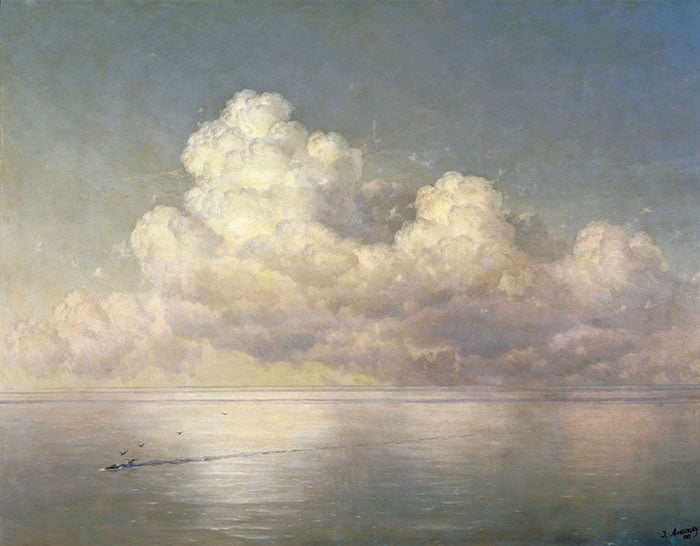
Ivan Aivazovsky, Clouds Over the Sea. At-home, 1889
Here'due south what I see (below). I've used boxes, but any uncomplicated shapes or forms will do—as long as it's uncomplicated! I took information technology a step further past suggesting the lite and dark planes (the nighttime planes are hatched). A secondary benefit of seeing clouds as bones forms is it helps you conceptualize ideas about light and shadow. Otherwise, y'all will need to rely almost entirely on observation, and perchance a chip of guesswork.
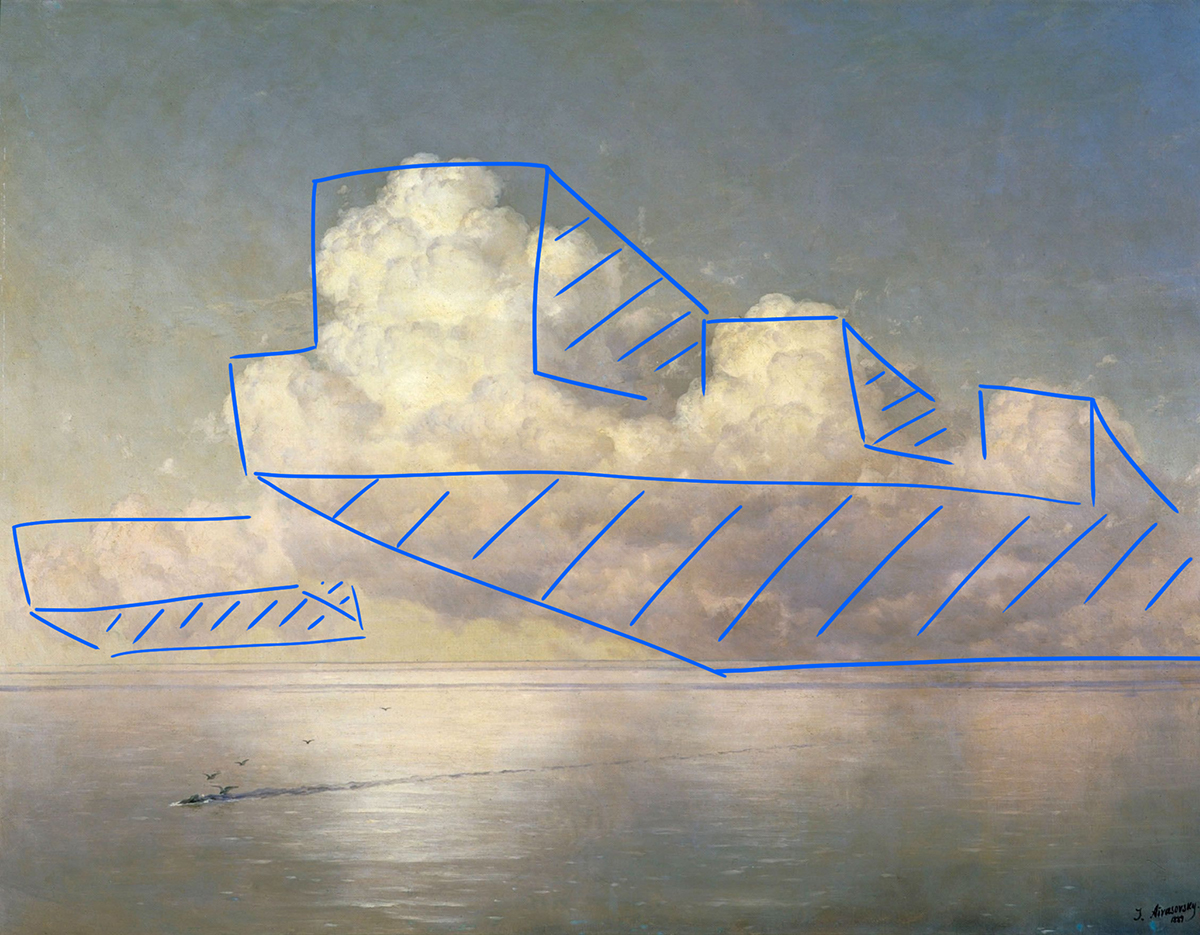
In this above example, I translated the clouds into basic iii-dimensional forms. Just sometimes shape is more than advisable, especially when the clouds are tightly compacted in the sky, diminishing whatsoever sense of singled-out course. (Note: Shape is basically a flat, or ii-dimensional version of a class—a circle is a apartment version of a sphere).
Have Isaac Levitan'southward A Stormy Twenty-four hour period (below). Clouds dominate the sky, so much so that information technology'due south impossible to brand out whatsoever distinct forms. Depth is implied by the overlapping shapes, rather than the rendering of three-dimensional forms. Shape is therefore more effective in simplifying all this item.
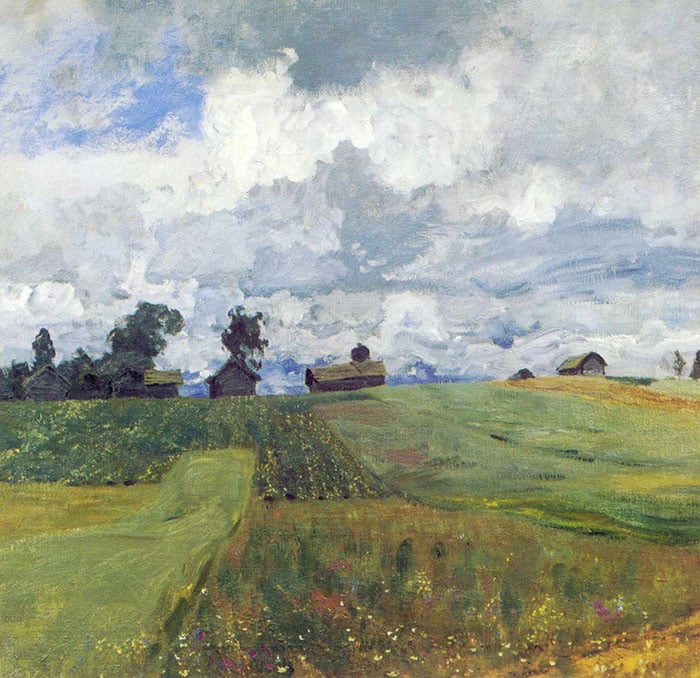
Isaac Levitan, A Stormy 24-hour interval, 1897
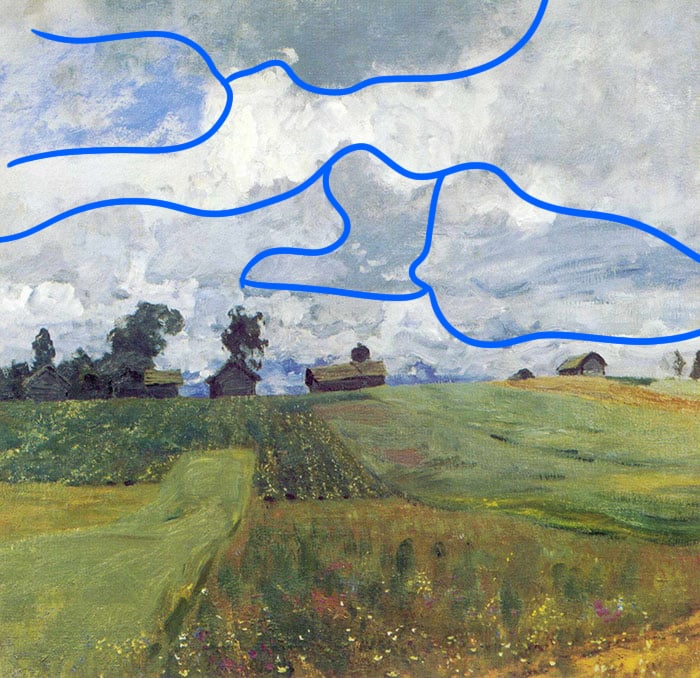
And don't forget negative space (the areasbetween the clouds—typically blue heaven). I've indicated the negative space in the below painting.
As with many aspects of painting, there are two ways you could deal with positive and negative space:
- You could paint in the clouds first (positive space) so fill in the gaps with color (negative space); or
- You could start with the bluish sky (negative infinite) then fill in the clouds (positive infinite).
Most aspiring artists ignore option 2—they focus on painting things, rather than the expanse between things. There's nothing incorrect with this arroyo, only sometimes it'south more effective to focus on the negative space commencement.
Negative infinite too acts as a useful audit tool to check if your positive space is correct. For example, say you are painting clouds in the heaven. You start by outlining the shape of the clouds. If your drawing is correct, then the shapes representing positive infinite should match the reference. If not, there's something wrong with your clouds. Errors often require a alter in your perspective before they rear their heads.
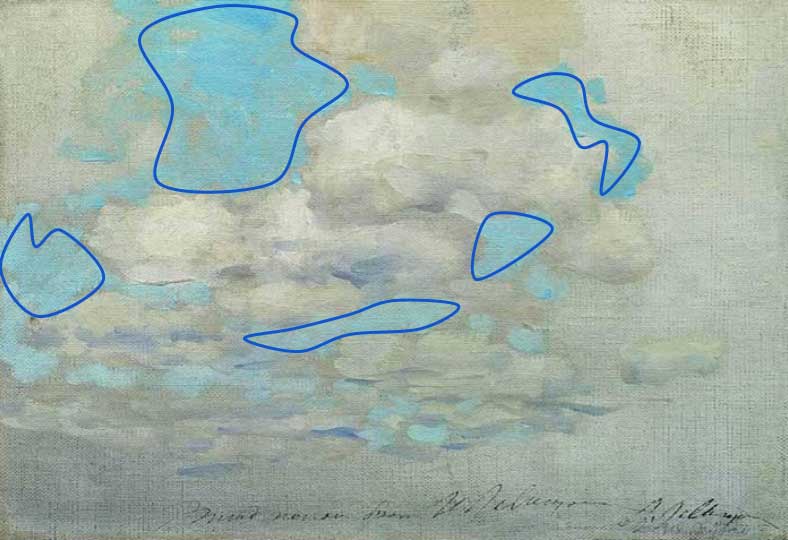
Endeavour it yourself. Go outside on a cloudy twenty-four hours and try to "encounter" the clouds as basic shapes and forms. Exercise this plenty and it'll eventually become second nature—you volition exist seeing the world as an artist.
(Note: This section applies more so to clouds that take a distinct form, with lite and dark planes, rather than clouds that are meliorate depicted past a flat shape).
Once you see clouds as basic shapes and forms, y'all can apply the laws of light as you would to whatever object.
To keep things uncomplicated, assume there's one light source—the Dominicus. Each cloud equals a simple form, be it a box, sphere, cylinder, cone, or combination. For each change in plane, at that place's a change in lightness. Planes facing towards the light will be lighter than planes facing abroad from light. Areas in light should be distinct from areas in shadow. Exist selective with your highlights and dark accents—less is more!
The position of the Sun in relation to the clouds determines which planes are hit by lite and which are in shadow. The nature of the light (strong, weak, direct, diffused, warm, absurd, etc.) influences the level of lightness (value) and colour temperature.
Get these fundamentals correct, and about of the hard work is done. You'll be costless to add your ain creative flair without compromising the sense of realism, whether that be energetic brushwork, subtle color transitions, a burst of low-cal, or a rich, dark accent. See John Singer Sargent'due south study below—it'south oozing with creative flare, just the fundamentals are stiff as ever with his work.
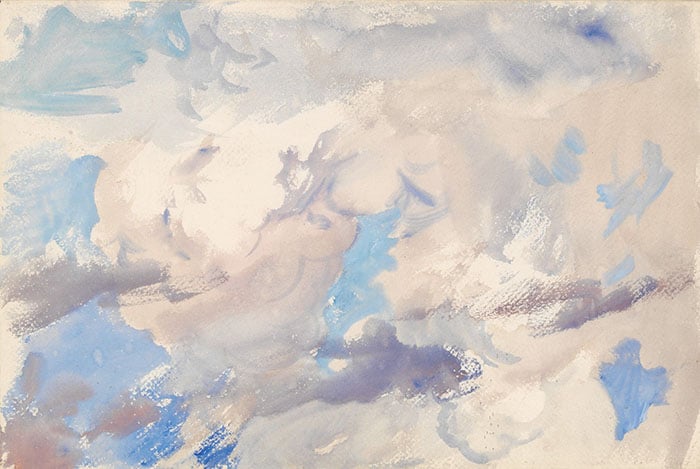
John Singer Sargent, The Sky, 1910
I'll run through some examples of how the laws of light use to clouds, starting with Sargent's Palazzo Labia. Venice. Sargent didn't mess around with subtle mid-tones—he kept things simple with distinct highlights and shadows. This plays well with the painting'southward loose fashion (highly rendered clouds would surely await out of identify, no matter how skillfully painted).
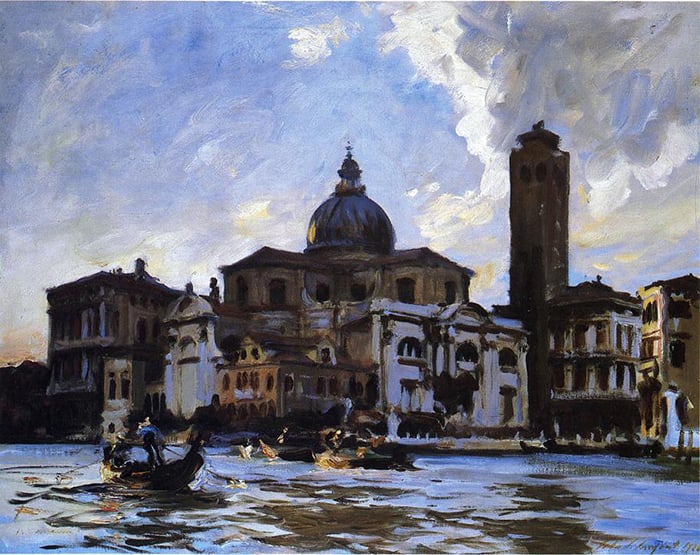
John Singer Sargent, Palazzo Labia. Venice, 1913
Below is a stunning painting by Claude Monet. The sky is a battle betwixt clean yellow highlights and scattered shadows. I tin can't easily explain how the laws of light piece of work in this painting, but it works all the same (as is the case with many great Impressionist paintings).
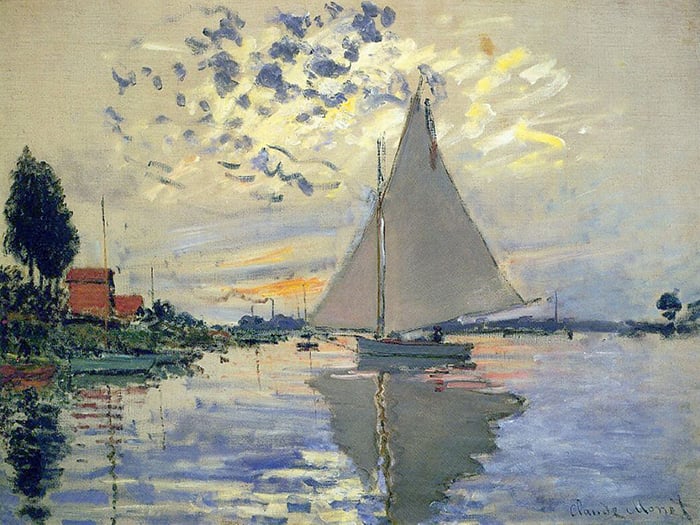
Claude Monet, Sailboat at Petit-Gennevilliers
Here's a moody seascape by Joaquín Sorolla. Instead of painting every detail, Sorolla picked a few important highlights and dark accents to do all the talking. Also detect the positioning of the highlights close to the dark accents, making them both popular.
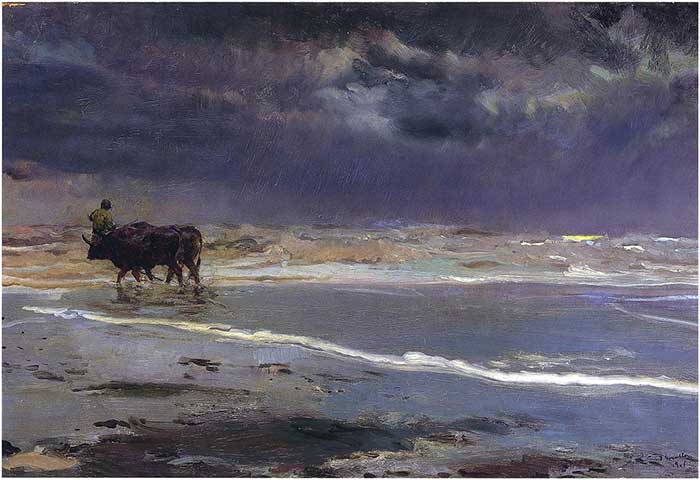
Joaquín Sorolla, Grayness Day On Valencia Beach, 1901
John Constable was always dramatic in his depictions of clouds and the landscape in general. He used his creative license to really push button the highlights and shadows, exaggerating the furnishings of light.
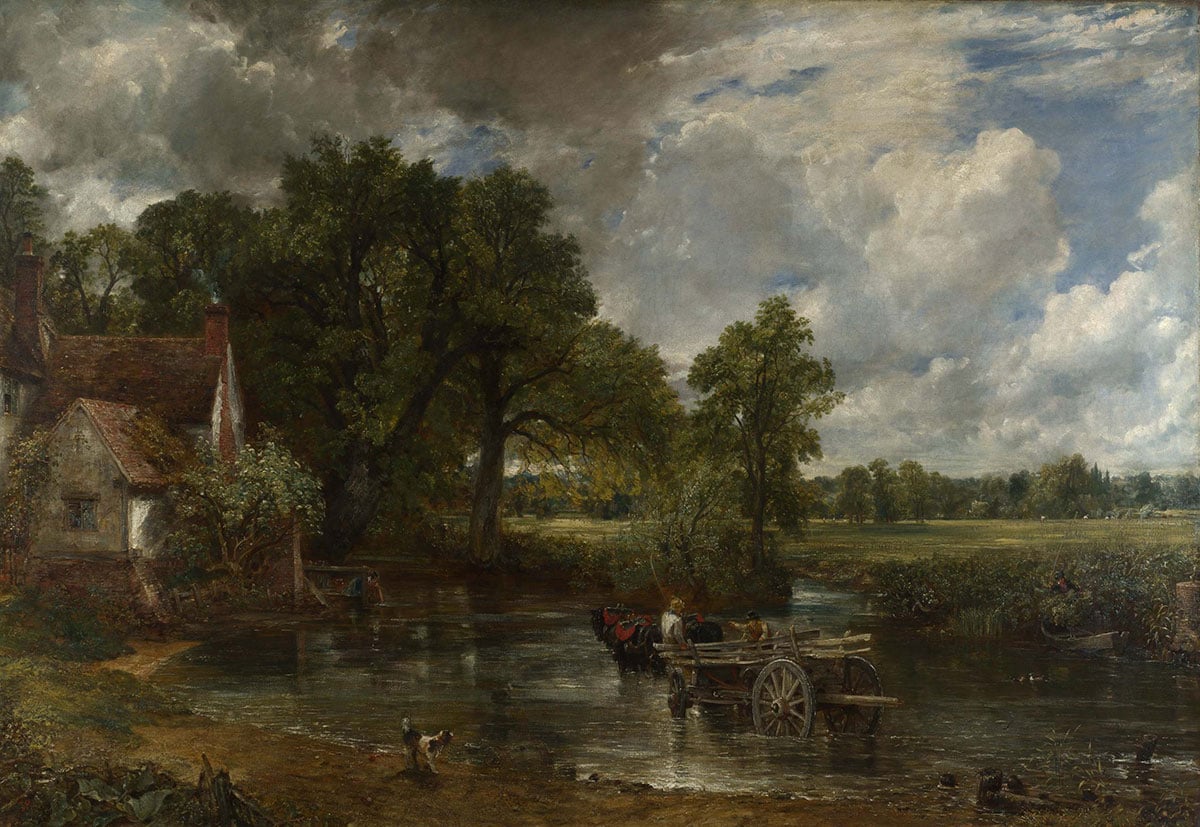
John Constable, The Hay Wain, 1821
In terms of color, clouds are typically limited to white, grays, and other weak tones. Rarely will you lot meet clouds bursting with color, bar maybe a vivid sunset. That doesn't diminish the importance of color, it just means y'all need to be restrained in your use of it. Call up subtle color transitions rather than bravado statements like you come across in Vincent van Gogh's piece of work.
Your color selections volition depend on factors such every bit:
- The nature of the light (how warm or cool it is).
- The overall primal (value range) of your painting. In other words, how light is your lightest light, and how nighttime is your darkest dark?
- The overall color theme of your painting. Y'all may decide to use colors that reverberate the overall theme rather than the colors you actually see.
Whatever yous practice, don't default to pure white for lights and dull blueish or greyness for darks. Have a strategy; remember critically about what colors you lot should use and why. If y'all're always in doubt, fall back to observation.
In my sunset painting beneath, the colors I used for the clouds were based on ascertainment and the overall theme of the painting. I used more blue than I actually saw, every bit it fit in better with the theme and created a sharper contrast against the sunset's warm colors.
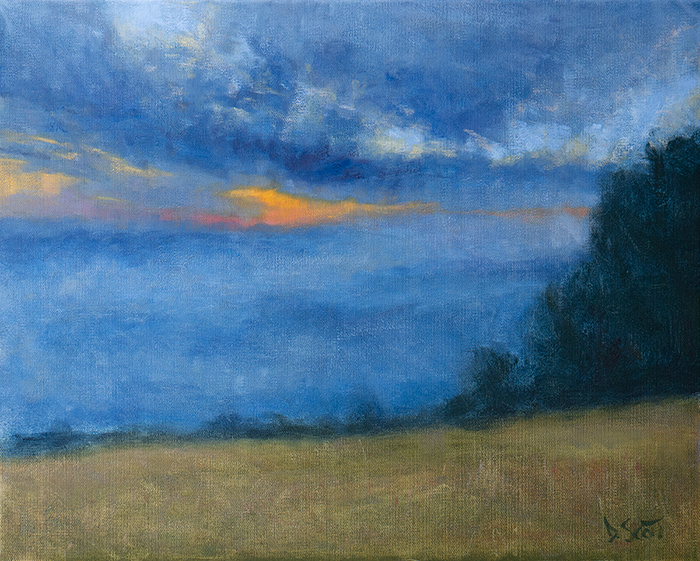
Dan Scott, Mt Tamborine Dusk, 2020
Gesture typically refers to the movement and menses of the human body. Portrait painters sympathize it deeply. Just nature likewise has a gesture; it's just hidden behind all the details.
Capturing nature's gesture will inject life and movement into otherwise static and apartment clouds.
A elementary style to understand gesture is to look at a cloud, or a group of clouds, and effort to capture it using a unmarried line. Remember of this every bit nature'southward gesture line. Build structure and class effectually it and let it guide your brush.
I've suggested the gesture line(south) in the following paintings. Keep in listen, this is non an exact science; it's just how I perceive gesture and motility.
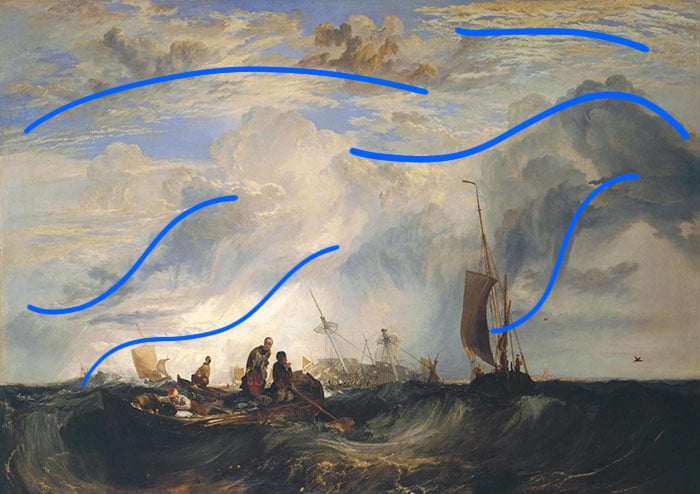
J.Thousand.W. Turner, Maas- A Merchant Send with Oranges on the Rocks, 1819
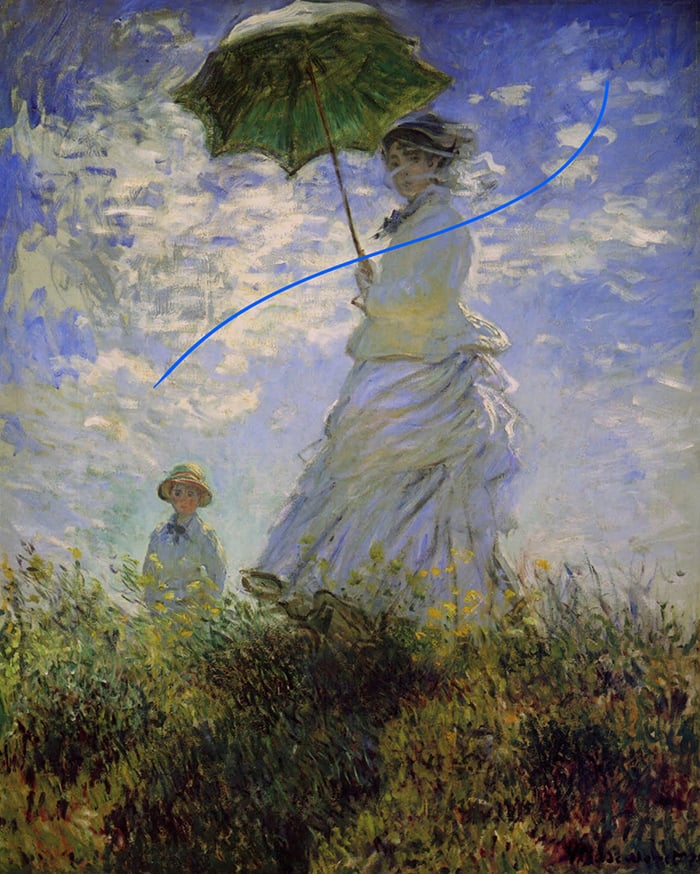
Claude Monet, Adult female with a Parasol (Camille Monet and Son Jean), 1875
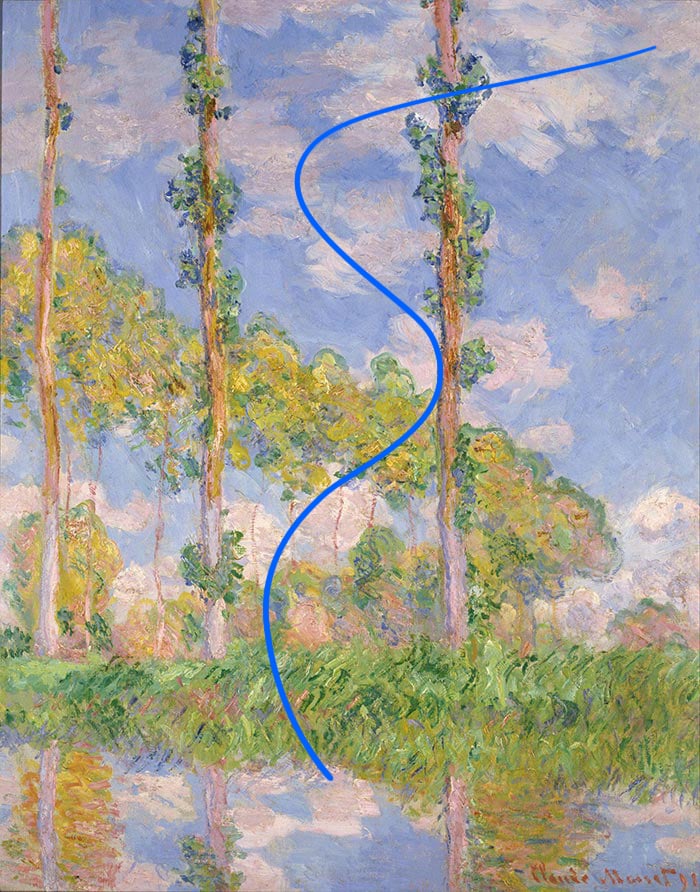
Claude Monet, Poplars in the Sun, 1891
Try it yourself. Where is the gesture in Levitan'southward painting below?
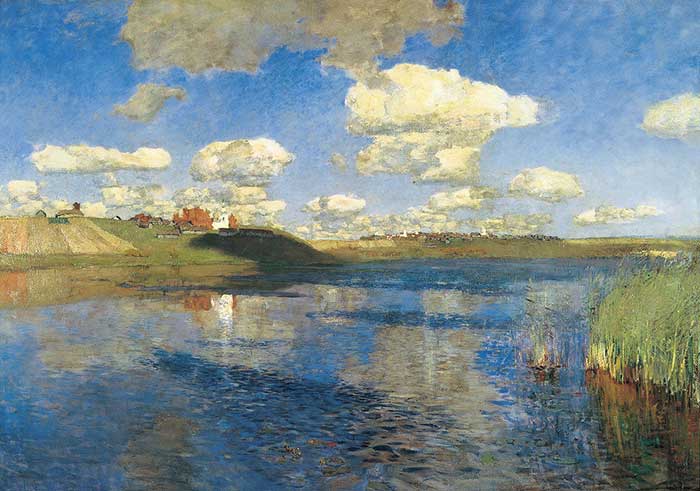
Isaac Levitan, Lake, Russian federation, 1900
Disallowment some stylistic choices, you will typically apply soft edges for clouds, with hard edges reserved for highlights and possibly dark accents. That's because clouds are soft, fluffy, and transient past nature. Overuse of hard edges tin make your clouds appear rigid and solid.
In Constable'due southRain Over the Ocean, difficult edges are only used in the heaven for some highlights; everything else is soft. The sea on the other hand is filled with hard edges, giving a sense of relative solidity (even if it is water). The horizon line is besides represented by a difficult edge, separating the heaven and sea.
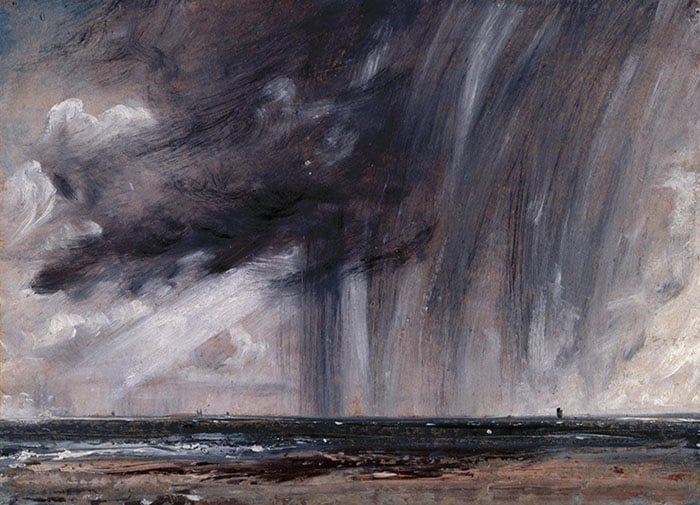
John Constable, Marine View with Storm Clouds (Rain over the Sea), 1827
It doesn't matter how well you lot paint something if it doesn't fit in with the residual of the painting. How oftentimes practise y'all run across paintings where the clouds, although meticulously painted, announced like cardboard cutouts glued onto the painting.
Every marker you make on the canvas must be done with the intention of improving the painting every bit a whole. This runs true for clouds, trees, rocks, water, people, edges, colors, shadows, or any role of the whole.
The key is to stay in touch with the big pic rather than getting lost in the details. Step back from your painting oft and purposefully. Wander effectually. Interrogate information technology. Expect for problems with the large picture, don't hibernate from them. (If yous spend all your time painting with your optics glued to the canvass, y'all might overlook the glaring error that can only be seen from afar).
Think well-nigh many of the great Impressionist works—from upwards close, you see an breathless mess of colour; but information technology all comes together as you footstep back. The Impressionists painted with the big pic in listen. You should do so equally well, regardless of your preferred style.
In my painting below, the clouds stand for stiff shapes in the overall composition. I didn't render them with intricate particular or capture every slight change in color. Instead, I simplified them to fit their role in the painting.
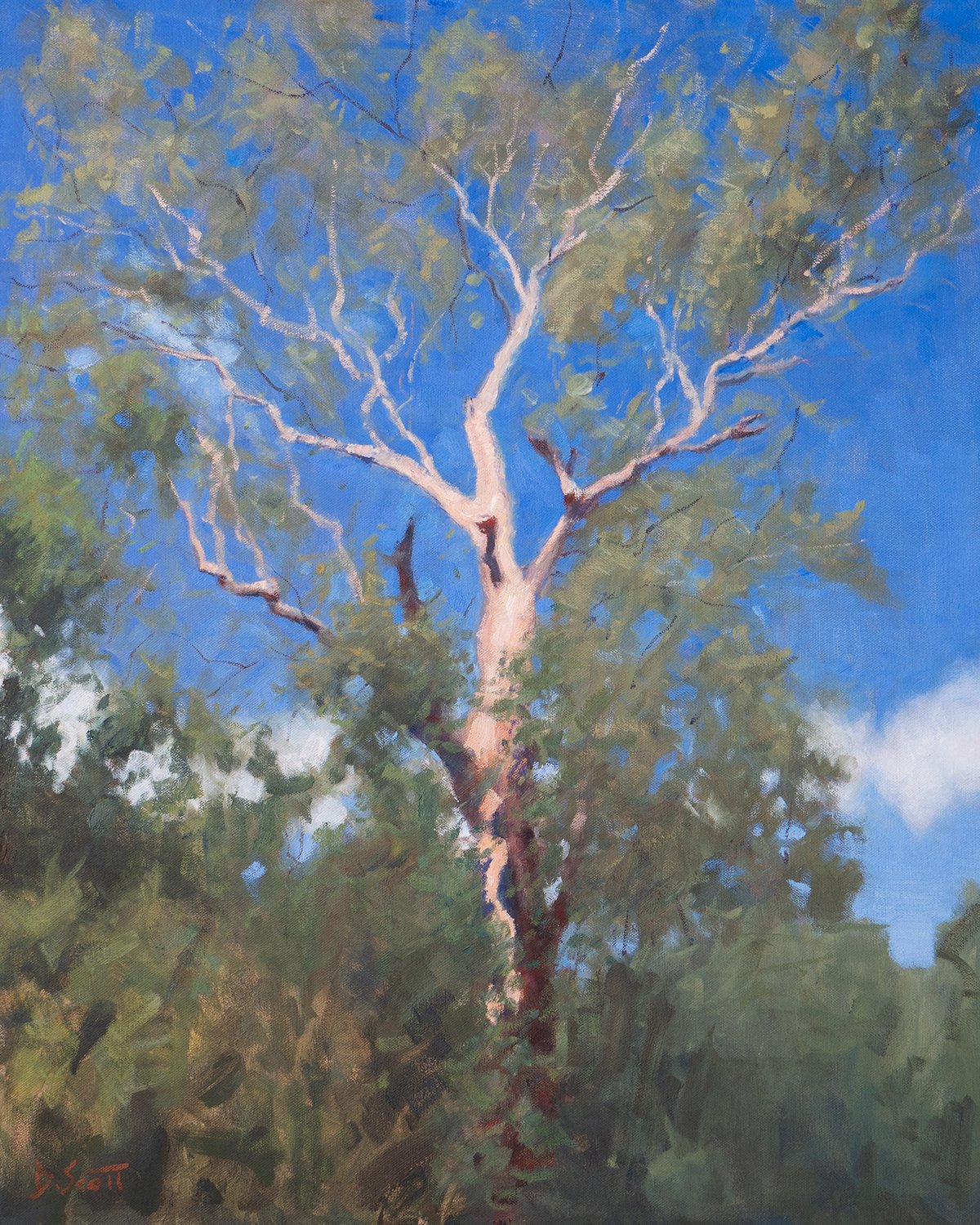
Dan Scott, Tree in Perspective, 2020
Clouds are a primal characteristic of Gustave Courbet's Calm Sea. But they aren't rendered with fine detail; rather soft edges, simplified brushwork, and compressed values (the lights and darks are restrained). This fits in with the residual of the painting and allows the two boats resting on the shore to control attending.
On a separate note, notice the sense of residue in this painting. The sky, ocean, and shore take up a vast majority of space, nevertheless it's the small boats resting on the shore, and fifty-fifty the ones sailing in the distance, that command attention. An interesting dissimilarity of big and quiet against small and noisy.
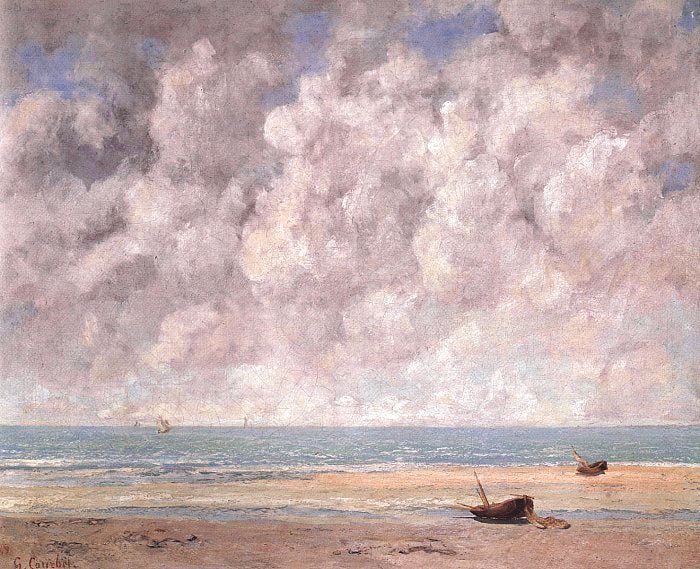
Gustave Courbet, Calm Body of water
In Monet'sImpression, Sunrise, the clouds are at that place for atmosphere, zilch more. There'south then picayune rendering that the clouds blend seamlessly into the rest of the painting.
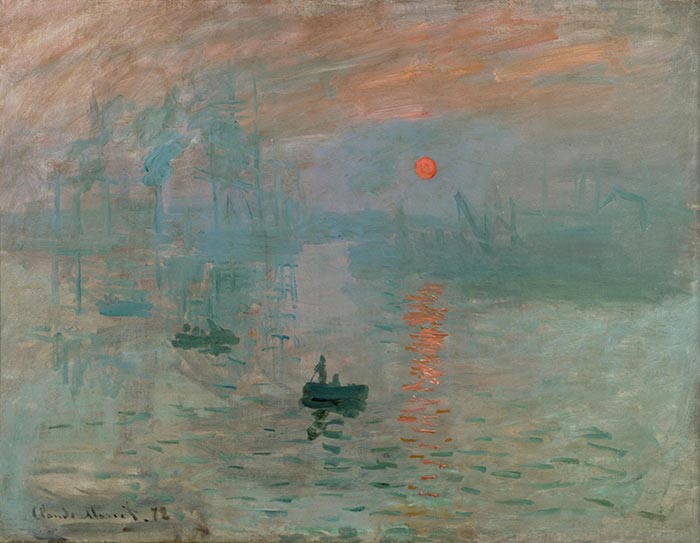
Claude Monet, Impression, Sunrise, 1872
In Levitan's Vladimirka, the clouds are rendered with rather fine detail, yet the sky as a whole is subtle compared to the state of dark colors and abrupt dissimilarity. Find how Levitan created depth in the sky by picking out a few clouds to detail, effectively pulling them frontward in perspective.
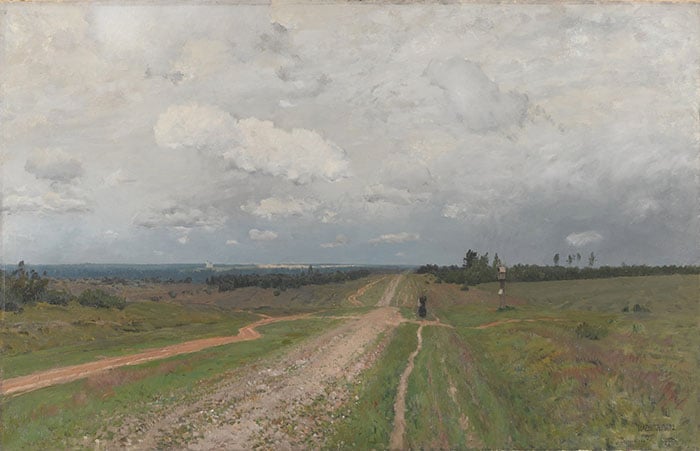
Isaac Levitan, Vladimirka, 1892
Ivan Shishkin's painting below is a great sit-in of relativity. The clouds were painted with intricate detail, powerful highlights, and crisp edges, yet I wouldn't say they're the focal point of the painting. The land, despite taking up less space in the painting, features a similar level of particular, along with night colors and far greater dissimilarity.
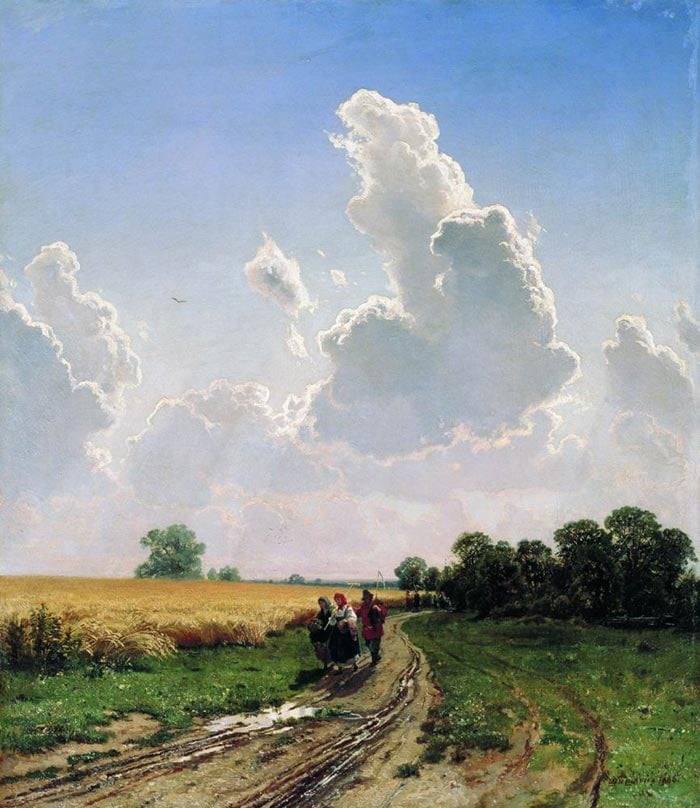
Ivan Shishkin, Noon, The Surroundings of Moscow, Brattsevo, 1866
- Clouds are fleeting and transient, just that doesn't mean yous should ignore structure and form. Seeing clouds every bit basic shapes and forms will assistance yous simplify and organize all the information.
- If y'all cannot make out distinct forms, use shape to simplify the clouds.
- Focus on getting the fundamentals of calorie-free and color right first, so inject your creative flair, if at all.
- Your use of colour will depend largely on the nature of the light, the overall key of your painting, and the overall theme.
- Much like the human being torso, nature also has a gesture. Information technology's what will give your clouds a sense of life and movement.
- You will by and large be dealing with soft and lost edges, plus a few hard edges for highlights and perhaps nighttime accents.
- It doesn't matter how well you paint the clouds if they don't fit in with the rest of the painting.
(If you desire to larn more about the principles of art, you might be interested in my Painting University course.)
Childe Hassam, Mountain Wood, 1908

Source: https://drawpaintacademy.com/clouds/
Posted by: rosspeat1973.blogspot.com
0 Response to "How To Draw A Cloud Youtube"
Post a Comment